


Moovha Wallet Provider Kit
Build a blockchain wallet service that lets applications request transactions on behalf of your users.
Wallet Provider Kit is a configurable wallet service and TypeScript toolkit for teams building and operating blockchain wallets for their users. Rooted in Moovha's work with blockchain payments and decentralised finance (DeFi), it makes access to on-chain assets such as USDC and ZARP easier to integrate into everyday products. It brings account creation, application-led access, account provisioning and approved-action signing into one toolkit. OWS stores the private owner signer for each user Safe. You define who may use an account and retain responsibility for key control and recovery.
In the standard application-led flow, users remain in the connected application. That application authenticates them, completes the required identity checks and records their wallet-access consent. It requests access on their behalf using its authenticated API client and a user assertion. Under an explicit trust agreement, the provider checks identity evidence, consent, current policy and permission limits, then stores a revocable grant. It does not require a second user login or routine staff review. Applications never receive private keys or seed phrases.
Read the application-led access contract for user binding, evidence, permissions, revocation and limits. Required fields or an OAuth scope alone do not establish identity or spending authority.
Connected applications are expected to cover the blockchain network fees, often called gas, for the supported actions they request. When a provider connects its wallets to Moovha with user approval, Moovha takes that sponsorship role for admitted operations. Providers should be able to integrate without building their own gas-funding rail or asking users to keep a separate gas-token balance. The assets and gas guide explains this project-supported rail, the application's obligations and the current implementation boundary.
Documentation · Get started · Service administration · Application management · Services and credentials · Run locally · Deploy static configuration
Deploy first, connect applications afterward
Install a wallet provider with zero connected applications. Establish administrator access, then register applications and configure their trust, action policies, services and sponsorship through the console or protected APIs. Installation needs no application RPC credentials, gas funding or external login provider. Wallet operations start disabled.
The installation guide describes local, Linux server and AWS template paths. Reviewed release bundles use prebuilt containers and Docker Compose; operators do not need Node, npm, Git or a source build. Check available releases for published artifacts. The package remains experimental and unpublished to npm.
For contributor evaluation from source, use Node 26.12.1, npm 11.11.1 and Git:
git clone https://github.com/Moovha/wallet-provider-kit.git
cd wallet-provider-kit
npm ci
npm run build
node dist/main.js init provider.config.json
node dist/main.js local-setup --config provider.config.json
The terminal installer prepares a disabled service. Open its /admin/ address and create the administrator with the private setup code or an explicitly approved Amazon Cognito sign-in. Choose networks, add applications and manage user checks in the console. Source users can inspect installation settings in JSON before running the installer.
Private setup codes expire after 30 minutes and succeed once. Optional Cognito bootstrap requires host approval of the directory and administrator group. Restart does not reopen registration. The persistent /admin/ console and provider API manage application registrations, identity trust, suspension, credential rotation and automation identities. Management availability is separate from wallet execution readiness. See installation and administration, application obligations and maintenance and recovery.
The bundle includes the OWS owner-signer engine, SQLite, the private Alto bundler, durable Valkey queues and Caddy HTTPS configuration. Each user receives a Safe; accepted application sponsorship funds its execution. Registration does not grant identity trust or spending authority. Provider acceptance and current owner, grant, KYC, consent, immutable action and durable attempt checks remain required.
The configuration reference covers static source integrations. Container/cloud acceptance and production custody acceptance remain separate from offline checks.
Who takes part
Your team is the wallet provider: it operates the wallet service for its users. The server application in which you run the toolkit is called the host.
| Term | What it means here |
|---|---|
| Account owner | The user your service records as owning a wallet account. They sign in and approve wallet access within the connected application. Also called the wallet owner; this doesn't by itself say who holds the private keys. |
| Connected application | Software, such as Moovha, that requests access to an owner's account through your wallet service. In OAuth configuration and API authentication, its registration is called a client. |
| Host authority | Your host's permission-checking code and stored records. Together they decide which owner and application may use an account, and which exact action is approved now. |
| Wallet backend | The wallet engine or signing service your host connects to. It creates or locates accounts and signs approved actions; its key-control and recovery model determines custody. |
Your product may contain both a wallet service and an application that calls it; the responsibilities still remain distinct. The concepts guide maps these names to configuration, API fields and the user's consent screen.
For your next step, follow the operator getting-started guide. For provider integration details, use the provider guide.
The approved contract-call guide explains per-user Safe accounts, explicit call consent, operation limits and verified outcome scopes.
A foundation for adopting teams
Operators can run wallet-provider-kit setup to configure supported deployments through installation settings, then run automated local container setup or export configuration and a deployment checklist. No application code is needed for this setup path.
The standard path is configure, deploy and consume the API. Use validated installation settings for OWS owner signing and SQLite storage, then manage application trust and policy through durable runtime APIs. The kit supplies consent, grants, account recovery, approved Safe calls and durable signing coordination. Start with service setup. Embedded host composition uses the same Safe execution contract.
The kit is for a team that wants to provide wallets as part of its own product, or make its wallet service available to other applications. Your users interact with the connected application’s login, identity and consent experience. Your host decides which connected applications can request access, which accounts they can use and which actions they may perform.
The supplied service uses application-led access with personal and shared Safe wallets per verified user. The original Personal wallet remains the default. See multiple wallets and members for wallet selection, member permissions and independent application consent. Application trust, spending policy and recovery remain under your team's control. Optional on-chain co-owners and signature thresholds add separate Safe signing authority. The toolkit publishes exact admitted signing payloads, collects owner signatures and executes once the current quorum is satisfied. Applications supply signer transport, local key storage and their signing experience.
Deploy the configured provider service and connect your product through its API. The toolkit can also be embedded as a Node.js package for advanced integrations. Its OpenAPI contract also lets applications written in other languages use the implemented service routes.
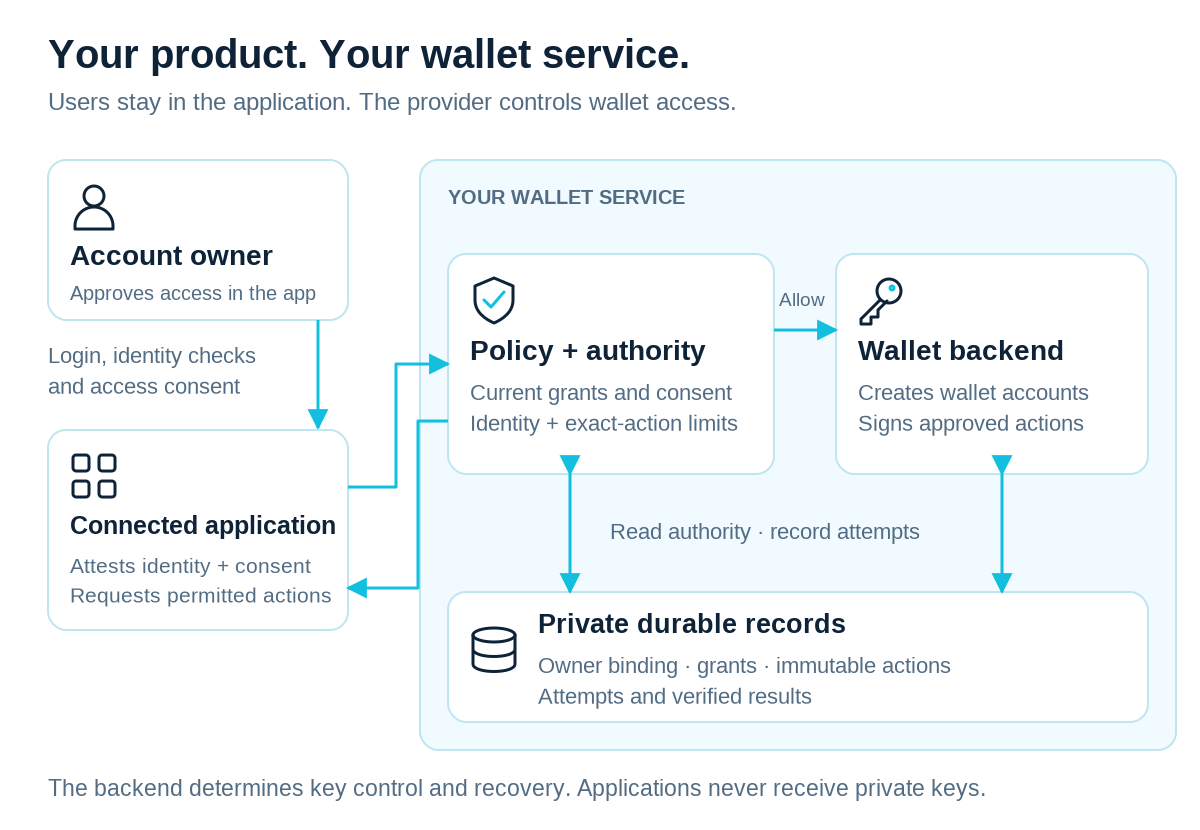
View full-size relationship diagram
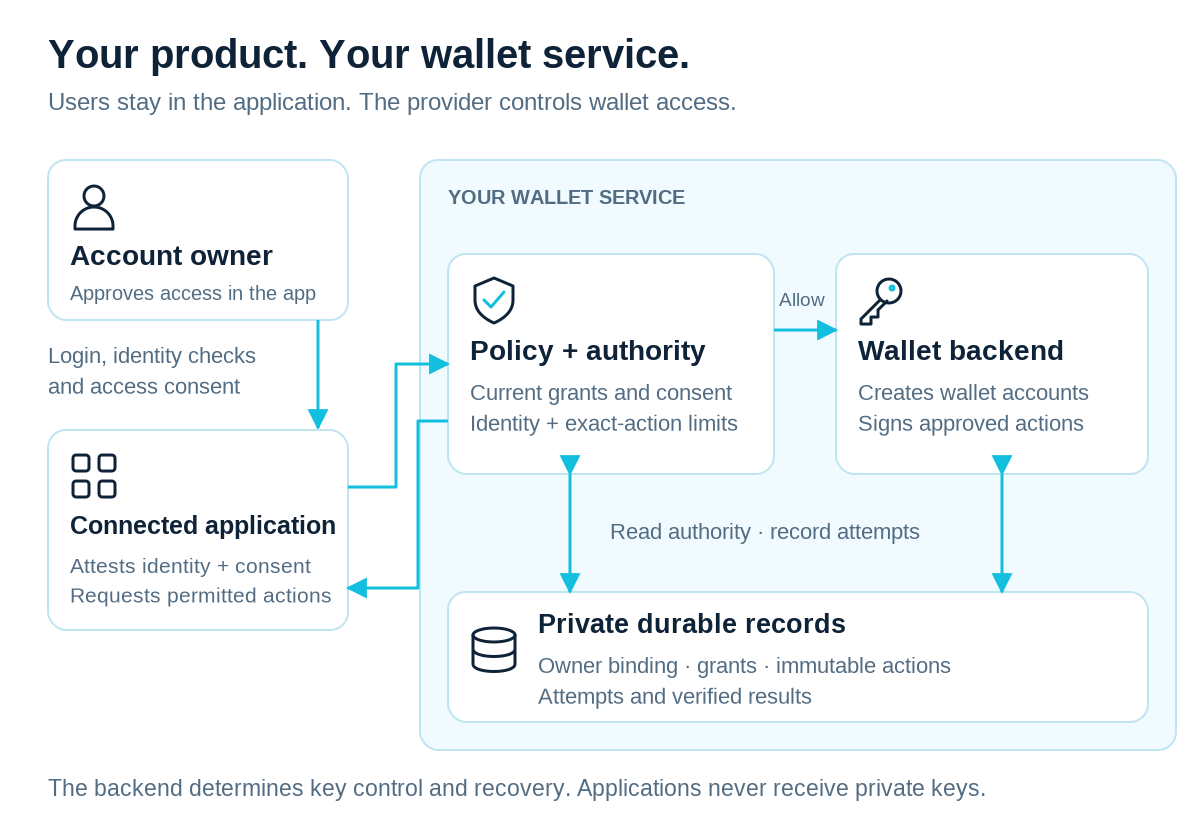
Your team configures the authority and backend shown inside the service boundary. For the supported service, the kit supplies the permission checks and durable records. The backend's control and recovery model determines custody; connecting an application doesn't transfer the wallet's keys to it.
How wallet access works
The application reads the provider's access policy and submits its stable user ID, accepted identity evidence and recorded consent for the current policy revision. The provider grants access only to an explicitly trusted application when those checks pass. Grants have specific permissions and an expiry. User IDs are scoped to the application: matching names or IDs in different applications do not link wallets. The application implements withdrawal and calls the grant-revocation API. See application-led access.
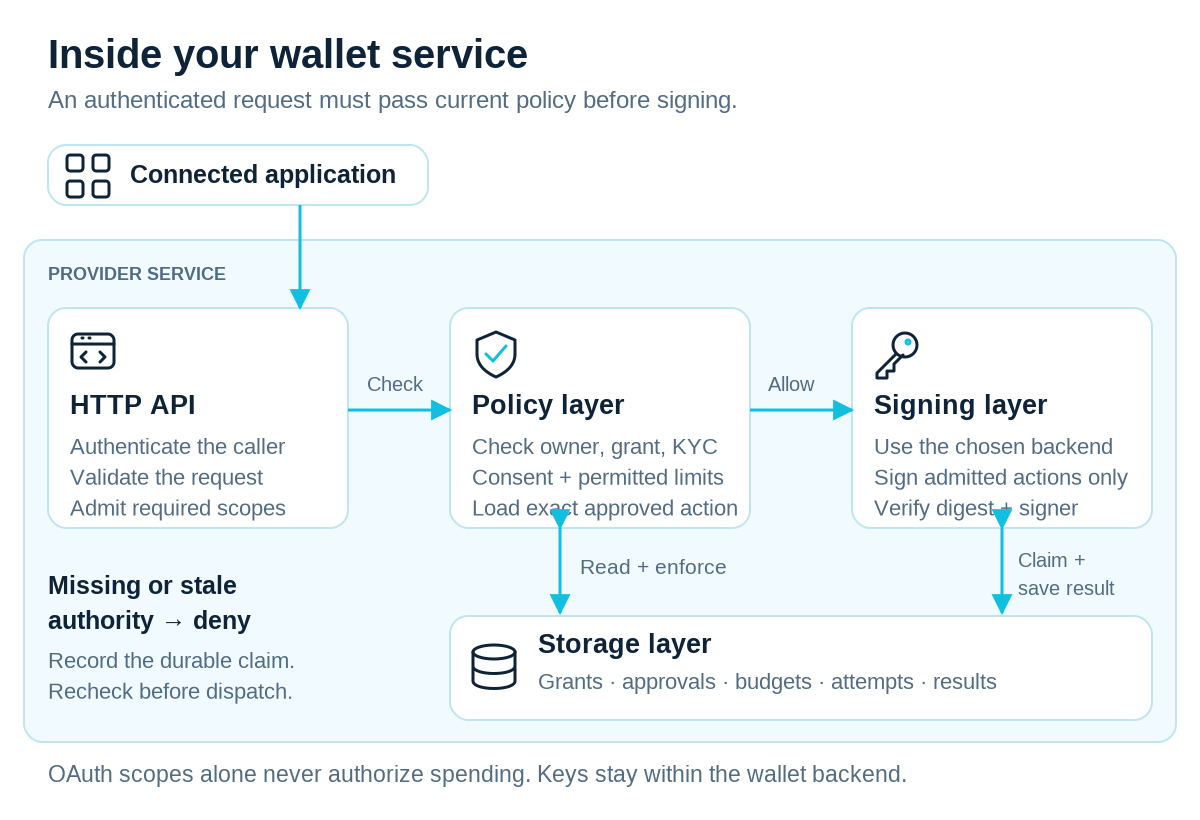
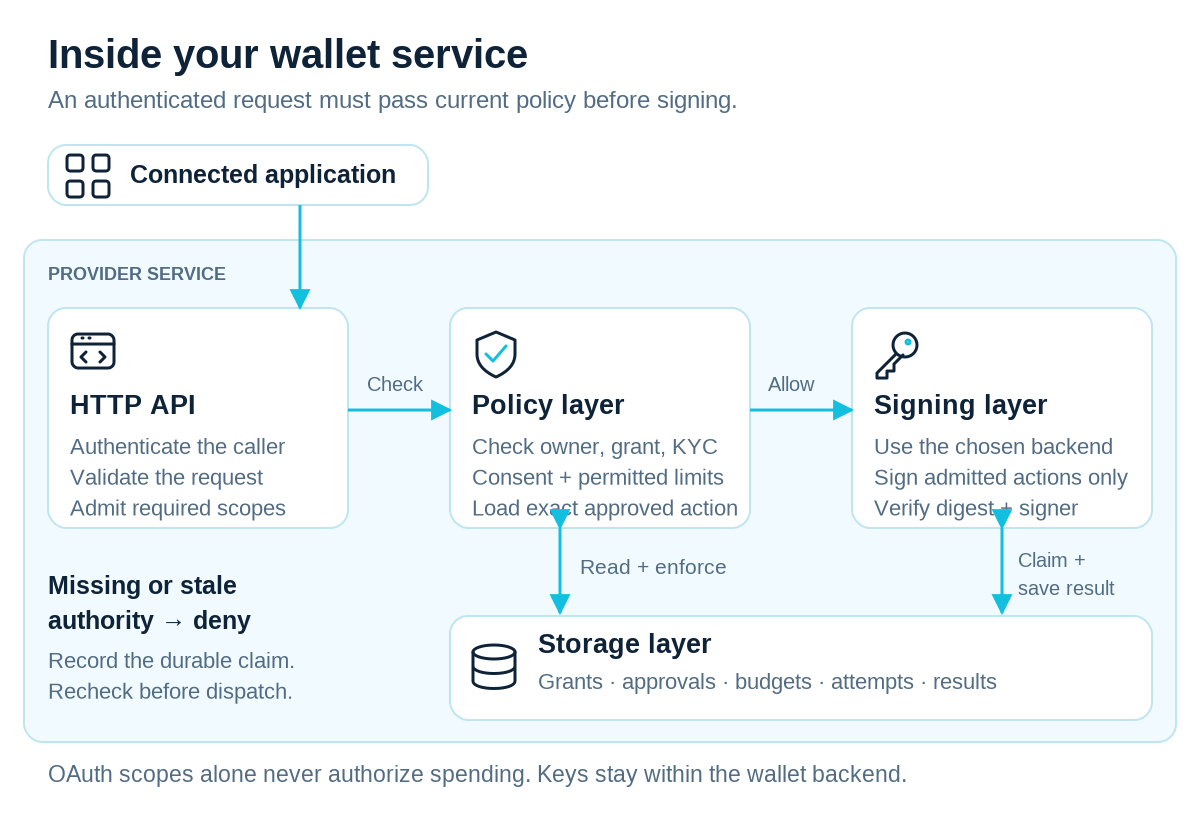
When an application requests an action, the host resolves the caller to the account owner and checks current access, consent and identity-verification status against stored records. These are provider checks, not fresh consent prompts. For signing, it also loads the exact approved action: an instruction stored by the host after authorising its exact content and limits. It records an attempt, the identity of this execution that retries must preserve, before the backend is called. The application references a stored action; it doesn't submit arbitrary bytes for the service to sign.
The user grants contracts:request consent in the application for the exact action_policy_revision. The application shows the permitted calls and limits, then submits approved atomic batches through the wallet-call API. The provider checks current authority, reserves bounded paymaster sponsorship and signs the immutable SafeOp before private bundler submission. See wallet calls.
The journal is the private, persistent record of attempts, their state and their results. The toolkit's journal wrapper coordinates the backend call, verifies its result and saves it through that journal. An authorised retry can then receive the saved result without repeating account creation or signing. If a response is lost, the original attempt stays pending or unknown until the host can establish what happened; this is called reconciliation. Current permission is checked again before returning a stored success. Ordinary application logs don't replace the journal. See attempts and recovery.
This separates the user's access consent, the host's authority and the backend's signing responsibility. OAuth scopes are named permissions on an application's access token. They allow a request to reach the host's policy checks. Spending authority also requires the current account owner, the application's grant (its stored, expiring access permission), Know Your Customer (KYC) status, user consent, the unchanged approved action and the recorded attempt. The provider guide and security model explain that contract.
The signing path below shows a new successful attempt. An authorised retry uses the stored result; a pending or unknown attempt requires reconciliation.
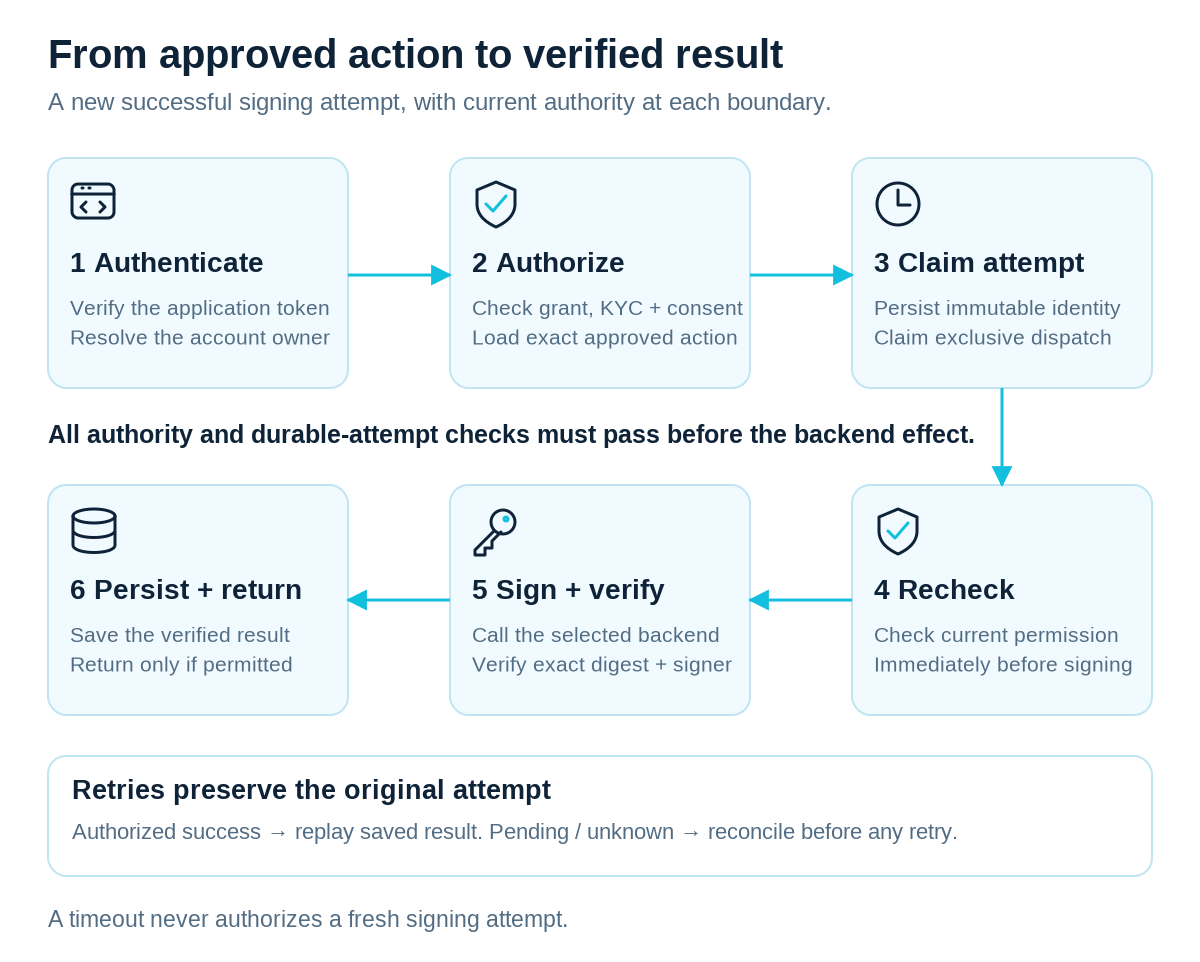
View full-size signing diagram
Where it fits in Moovha
Moovha's foundations are on-chain transfers, swaps and access to DeFi through assets such as USDC and ZARP. These wallets hold blockchain assets and authorise transactions involving token and vault contracts. A simple product experience still needs to make the asset, network, approval and fees clear.
Wallet Provider Kit lets independent wallet providers connect their services to applications such as Moovha. The provider checks access and signs approved actions while keeping Safe owner keys within its private OWS vault.
Learn about Moovha and explore the Moovha GitHub organization.
Moovha's business-operation API coordinates transaction intent, sponsorship, execution and settlement. Device-wallet backup and recovery are separate application responsibilities. The architecture guide explains the provider boundary and application access.
Gas sponsorship is part of that integration design: the connected application funds eligible network fees while the provider retains wallet control and checks the user's authority. It does not require sharing keys with the application.
Non-custodial application access describes Moovha's relationship to the wallet's keys. Exclusive end-user self-custody depends on who can actually control and recover the chosen backend. Explain that control and recovery model to your users.
What is available today
The package includes a wallet service and signing interfaces, a journal-backed provider wrapper, application-led access management and optional hosted compatibility onboarding, OAuth token verification, generated OpenAPI and optional OpenTelemetry monitoring.
Open Wallet Standard stores the private Safe owner signers. The private Alto bundler and application verifying paymaster supply the only user execution flow. Each user receives their own Safe address for deposits and calls.
The current version, 0.1.0, is experimental and available from source rather than npm. You can configure account access and provisioning, and execute approved Safe contract calls, swaps and vault deposits on Base mainnet, Base Sepolia, Ethereum mainnet or Ethereum Sepolia. Start with the setup guide; application connection follows deployment.
Your first deployment stays disabled while you test your backend, application permissions and recovery. The supported runtime uses one active POSIX host with persistent SQLite storage. Production custody acceptance and funded mainnet acceptance remain pending. USDC and ZARP illustrate the wider project's asset use cases; verify the exact network-specific token contract and signing domain before configuring transfers.
Configure your wallet service
Separate installation settings from application runtime policy. Choose the provider's final HTTPS identity and retained storage during deployment. Claim administration, then register applications when they connect. Use the console or API to accept identity/consent trust and configure permitted owner actions.
Applications register action payloads, service credentials and bounded gas sponsorship through protected APIs. Provider operators accept the resources and prepare funding and bundler/paymaster infrastructure separately. User assets stay in individual Safes. Follow the application setup sequence.
The getting-started guide covers installation. The advanced configuration reference documents static source setup.
Connect and operate
After deployment, give your application developer the provider origin, token registration and HTTP contract. Applications read your current policy, submit identity and consent evidence, receive a revocable grant and provision the wallet. Optional signing and execution need their own explicit permissions and accepted policies. The access guide describes this sequence; the staging walkthrough helps you test it with your own services.
An authorization signature, transaction submission, verified chain result and business settlement describe different outcomes. Applications fund the verifying paymaster and private bundler for the Safe execution flow. One instance can offer Base mainnet, Base Sepolia, Ethereum mainnet and Ethereum Sepolia. Choose a default network during installation and additional networks in administration. Verified identity and application registration are shared; wallets, consent, transaction rules, execution and fee funding remain separate for each network. Existing integrations keep their default network and account URLs. See network setup and selection. Applications use the account wallet endpoint; no raw-signature endpoint is exposed.
Extend the service
Use the developer API guide for reviewed host composition and the TypeScript declarations for exact interfaces. Embedded hosts use the same Safe/bundler/paymaster flow. These interfaces are optional; they are not prerequisites for installation.
Contribute
Use GitHub issues for bugs and integration questions. Contributions follow the contributor guide, governance and code of conduct. Report vulnerabilities through SECURITY.md. See the changelog and release process for version history.
Apache-2.0. See NOTICE and source provenance.